Music Has a Morality
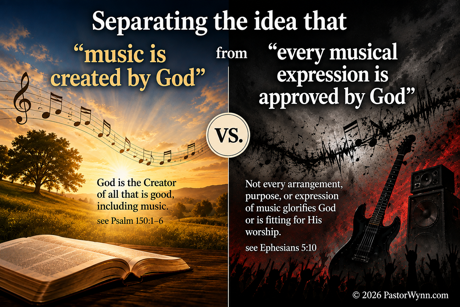
A Biblical Rebuttal to John Cooper, of Skillet. Separating the idea that “music is created by God” from “every musical expression is approved by God,”
Read the FoxNews article HERE
FoxNews published the linked article on Saturday, August 22, 2026. In the article Cooper recently argued that Christians who believe certain forms of rock music can be inherently wrong are not only mistaken about music, but are “getting the gospel wrong.” I believe Cooper has gone too far.
Let me begin by making an important distinction. I do not believe that a musical note is sinful. I do not believe that a drum, guitar, piano, organ, or any other musical instrument is inherently evil. Nor does the Bible give us a list of musical instruments or modern musical genres that are inherently sinful. However, that is very different from saying that music itself is amoral.
Cooper argues that morality lies essentially in the lyrics, intention, and heart of the musician. He states, “It’s the lyrics. It’s what you do with it. It’s not in a sound. It’s in a heart posture.” There is certainly truth in part of that statement. Lyrics matter. Intentions matter. The spiritual condition and purpose of the person producing music matter.
But is that all that matters? I do not believe Scripture permits us to draw that conclusion.
Music Communicates Apart From Words
One of the fundamental weaknesses of the “music is amoral” argument is that it treats music as though it were merely a neutral vehicle carrying words. Yet we know that music communicates even when there are no words at all. Paul illustrates this principle in 1 Corinthians 14:7–8:
“And even things without life giving sound, whether pipe or harp, except they give a distinction in the sounds, how shall it be known what is piped or harped? For if the trumpet give an uncertain sound, who shall prepare himself to the battle?”
Notice Paul’s reasoning: sound communicates information.
The trumpet did not need lyrics saying, “Prepare for battle!” The arrangement of the sounds themselves communicated the message. That does not prove that a particular modern musical genre is sinful. We should not make the passage say more than it says. But it does destroy the simplistic proposition that musical sound communicates nothing morally significant apart from lyrics. Music communicates. Consider this practically.
Play a military march without lyrics, and it can communicate courage, strength, order, and movement. Play a funeral dirge without lyrics, and it communicates sorrow and mourning. Play a lullaby without lyrics, and it communicates tenderness and rest. Play suspenseful music during a motion picture, and the audience senses danger before anything dangerous appears on the screen.
If music were truly nothing more than an amoral collection of sounds, none of this would be possible. The notes themselves may be morally neutral in isolation, just as individual words of the English language may be morally neutral in isolation. But once those notes are deliberately arranged through rhythm, harmony, melody, tempo, dynamics, repetition, and instrumentation, they become communication. And communication cannot simply be dismissed as morally irrelevant.
Scripture Connects Music With the Affections
The Bible repeatedly connects music with man’s inner life. Paul commanded:
“Speaking to yourselves in psalms and hymns and spiritual songs, singing and making melody in your heart to the Lord.” (Ephesians 5:19)
Likewise: “Let the word of Christ dwell in you richly in all wisdom; teaching and admonishing one another in psalms and hymns and spiritual songs, singing with grace in your hearts to the Lord.” (Colossians 3:16)
Biblical music does something. It teaches. It admonishes. It expresses worship. It engages the heart. It directs the affections toward God.
David’s playing affected Saul emotionally: “And it came to pass, when the evil spirit from God was upon Saul, that David took an harp, and played with his hand: so Saul was refreshed, and was well...” (1 Samuel 16:23)
Whatever theological questions surround that passage, one fact is unmistakable: the music affected Saul.
If music affects the emotions, influences the body, shapes the atmosphere, communicates ideas, and directs the affections, it becomes exceedingly difficult to maintain that music is simply “amoral.”
The Issue Is Not Whether an Instrument Is Evil
This distinction is essential. A drum is not evil. An electric guitar is not evil. A particular chord is not evil. A particular rhythmic subdivision is not evil. But it does not follow that every possible arrangement of rhythm, melody, harmony, instrumentation, volume, performance style, and cultural association is therefore equally suitable for Christian worship.
That conclusion simply does not follow. Words provide a useful analogy.
The alphabet is morally neutral. There is nothing sinful about the letters A through Z. Yet those morally neutral letters can be arranged to communicate blasphemy, obscenity, seduction, worship, truth, beauty, or praise.
The human body is God’s creation. Yet bodily movements can communicate dignity, affection, aggression, sensuality, reverence, or vulgarity without a single spoken word.
Paint is morally neutral. Yet an artist can arrange paint upon a canvas to produce either something beautiful and wholesome or something pornographic and degrading.
Why, then, should music alone be placed into a special category in which its arrangement supposedly communicates nothing morally relevant?
Scripture Requires More Than Good Intentions
Cooper places considerable emphasis upon intentionality and “heart posture.” Certainly the heart matters. God looks upon the heart. But sincerity does not sanctify everything we do.
Scripture says: “Proving what is acceptable unto the Lord.” (Ephesians 5:10)
And again: “Prove all things; hold fast that which is good.” (1 Thessalonians 5:21)
Paul gives an even broader principle:
The Christian question cannot merely be: “Do I have good intentions?” It must also be: “Is what I am doing acceptable unto the Lord?” Paul would write, “Whether therefore ye eat, or drink, or whatsoever ye do, do all to the glory of God.” (1 Corinthians 10:31)
“Whatsoever ye do” certainly includes music. Therefore, Christian musicians and churches should be willing to examine not merely their lyrics, but the totality of their musical expression.
- Does it glorify God?
- Does it reflect His character?
- Does it encourage holiness?
- What affections does it cultivate?
- What does it communicate?
- What does it cause the listener to associate with the message being presented?
Does the musical expression complement the truth being sung, or compete with it? These are legitimate biblical questions.
We Must Also Be Careful About Cultural Association
This does not mean that every musical form originating outside the church is automatically sinful. Christians have sometimes made that argument carelessly, and history demonstrates the danger of declaring something sinful merely because it is new or unfamiliar. Nevertheless, culture matters.
Paul wrote: “All things are lawful for me, but all things are not expedient…” (1 Corinthians 6:12)
And: “Abstain from all appearance of evil.” (1 Thessalonians 5:22)
Christians do not live in a cultural vacuum. Sounds, clothing, gestures, symbols, artistic forms, and performance styles develop associations. Wisdom requires us to consider those associations rather than pretending they do not exist. That is particularly important in corporate worship.
The question is not merely whether something can technically be defended. The question should be whether it is fitting for the worship of a holy God.
Cooper’s Most Serious Overstatement
However, I believe the most troubling statement in Cooper’s argument is his assertion that Christians who disagree with him are “getting the gospel wrong.” That is a very serious accusation.
What is the Gospel? Paul tells us plainly:
“For I delivered unto you first of all that which I also received, how that Christ died for our sins according to the scriptures; And that he was buried, and that he rose again the third day according to the scriptures:” (1 Corinthians 15:3–40
That, my friend, is the whole of the gospel!
The Gospel concerns the death, burial, and resurrection of Jesus Christ and the salvation God provides through Him.
Two Christians may disagree concerning the appropriateness of a particular musical style without either one denying the Gospel. Cooper may believe that conservative Christians are mistaken about music. He has every right to make that argument and attempt to demonstrate it from Scripture. But to suggest that disagreement with his philosophy of music constitutes misunderstanding the Gospel unnecessarily elevates his own musical philosophy to a doctrinal position Scripture itself does not give it. Ironically, that is precisely the sort of mistake that advocates of contemporary Christian music have frequently accused traditionalists of making.
The Better Biblical Position
Satan created neither music nor musical instruments. God is the Creator of sound, human creativity, musical ability, rhythm, melody, and harmony. But neither should we embrace the opposite extreme and conclude that because God created sound, every arrangement and expression of sound is therefore morally equivalent.
- God created language, but every use of language does not please Him.
- God created the human body, but every use of the body does not glorify Him.
- God created human sexuality, but every expression of sexuality is not righteous.
- God created artistic ability, but every expression of art is not holy.
And God created music, but it does not therefore follow that every musical expression is equally appropriate for the Christian.
The question is deeper than, “Does this song have Christian words?” The Christian must ask whether the whole musical expression of lyrics, melody, harmony, rhythm, performance, presentation, associations, purpose, and effect is consistent with the character of the God Whom we claim to worship.
Our standard cannot merely be what appeals to us. It cannot merely be what reaches the largest audience. It cannot merely be what the culture enjoys. And it certainly cannot merely be what the performer sincerely intends.
Our standard must remain: “Proving what is acceptable unto the Lord.” (Ephesians 5:10)
That is not legalism. That is Christian discernment.
Let us not be deceived, nor be led astray, by the false ideology and theology that music itself is amoral. Rather, let us seek the which glorifies our Lord in all aspects.
Editorial Disclosure: This article represents the original thoughts and conclusions of the author. ChatGPT was used as an editorial tool for proofreading, grammar, clarity, and stylistic refinement. The author reviewed and approved the final content.