
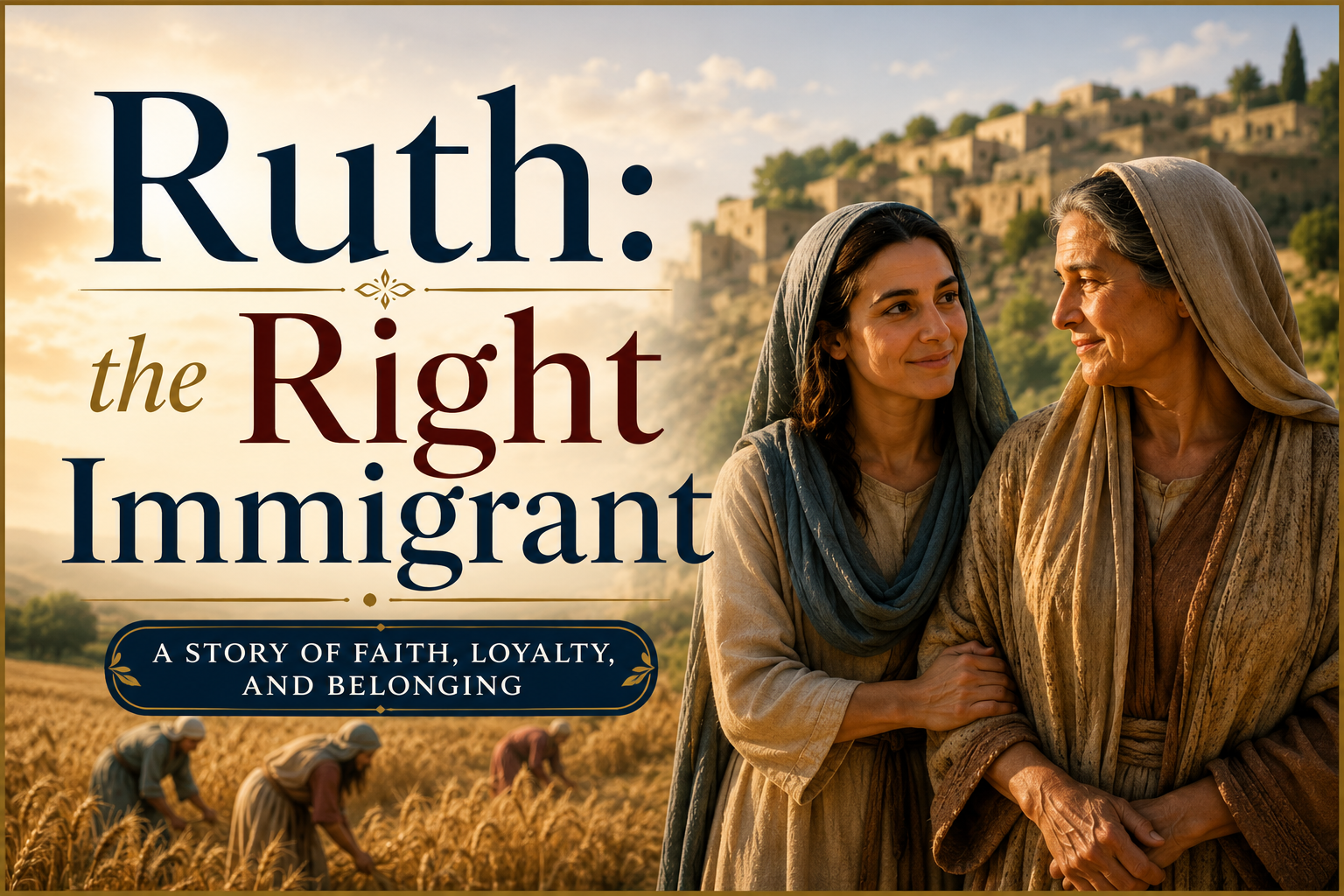
Ruth: the Immigrant
Text: Ruth 1:16-17; 2:11
The story of Ruth captivates the mind and engages the heart. Throughout this beautiful account, we see both the providence and sovereignty of God as He guides and directs the affairs of men.
The story opens with a man named Elimelech leaving Bethlehem with his wife, Naomi, and their two sons. Bethlehem—the “house of bread”—had no bread because famine had come upon the land. This occurred during the days of the Judges, a period characterized by the tragic statement that “every man did that which was right in his own eyes” (Judges 17:6; 21:25).
Elimelech took his family into the land of Moab. This was no insignificant destination. There was a Divine restriction concerning the Moabites and the congregation of Israel. It was a Divine prohibition against Moabites entering the congregation of the Lord (Deut. 23:3-6). It states that “An Ammonite or Moabite shall not enter into the congregation of the LORD; even to their tenth generation shall they not enter into the congregation of the LORD for ever.” The restriction was grounded in historical grievance—the Moabites had refused to provide hospitality to Israel during their exodus from Egypt and had hired Balaam to curse them. The law further commanded Israel to “not seek their peace nor their prosperity all thy days for ever.”
While the text of Ruth does not explicitly state that Elimelech violated a particular command of the Law by moving to Moab, his decision took his family away from the land of Israel and into a nation historically hostile to the people of God. What followed was tragedy. During Naomi’s years in Moab, she buried her husband and both of her married sons.
At this point, Naomi is ready to return back to her homeland. As those familiar with the story know, Orpah went back home to her family. Ruth, however, was determined to go with her. She would immigrate to Israel. Her declaration to Naomi, Ruth 1:16-17, is on that is still well-known today and is even used in modern day wedding ceremonies.
(Ruth 1:16-17)
And Ruth said, Intreat me not to leave thee, or to return from following after thee: for whither thou goest, I will go; and where thou lodgest, I will lodge: thy people shall be my people, and thy God my God: ”Where thou diest, will I die, and there will I be buried: the Lord do so to me, and more also, if ought but death part thee and me.”
Ruth: The Immigrant
Ruth determines to leave everything behind her. Boaz would declare “…It hath fully been shewed me, gall that thou hast done unto thy mother in law since the death of thine husband: and how thou hast left thy father and thy mother, and the land of thy nativity, and art come unto a people which thou knewest not heretofore” (Ruth 2:11, emphasis added). She did not come to Israel to try to turn it into Moab. She left Moab behind!
More importantly, she did not merely change her geographical location. She identified herself with a new people and with their God. Her declaration was unmistakable: “thy people shall be my people, and thy God my God.”
Ruth was not like the leftist of our day that embraces illegal immigration by those who do not want to become like our people, and our God. They embrace that which wants to transform our nation into that which more like Moab than Israel.
Ruth was a model example of how immigration should function and what it should embrace.
Of course, immigration is not the primary theme of the book of Ruth. We should never force a secondary application upon a biblical text and make it the meaning of the passage. Ruth is ultimately a magnificent account of God’s providence, redemption, covenant faithfulness, and sovereign purpose. Through this Moabite woman, God would continue the royal line that would lead to David—and ultimately to Jesus Christ (Matthew 1:5–6).